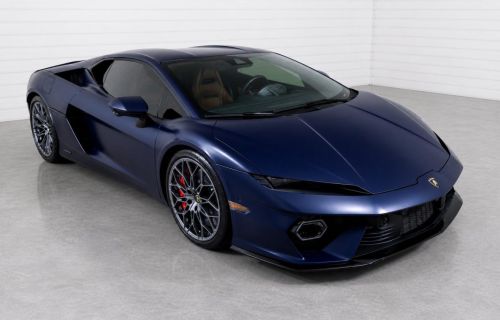
The changing of the guard at Sant'Agata Bolognese is always dramatic, but with the launch of the Lamborghini Temerario, the Italians haven't just turned the page—they've burned the rulebook written for "junior" supercars.
If the Huracán was an ode to atmospheric purity, then the Temerario is a manifesto of technocratic supremacy.
It is no longer an “entry ticket” into the world of Lamborghini, but an engineering pinnacle in its own right—a car that, with cynical composure, blurs the line between road-going grand touring and a GT3-class track car.
Its philosophy is built on the HPEV (High Performance Electrified Vehicle) concept, where electricity serves not the environment, but exclusively speed, filling the slightest pauses in the internal combustion engine’s breath.
At the heart of this engineering masterpiece is an entirely new powertrain, developed from the ground up.
Saying goodbye to the legendary V10 was painful, but in its place, the engineers offered something extraordinary: a 4.0-liter twin-turbocharged V8. This is not an adaptation of the Urus’s engine, but a unique flat-crankshaft engine capable of revving up to a stratospheric 10,000 rpm.
The turbos, located in the cylinder block’s V-angle (the “Hot-V” layout), provide instant response, but it is the hybrid component that changes the game.
Three electric motors—one integrated into the new 8-speed dual-clutch transmission, and the other two driving the front axle—create the effect of a continuous flow of torque.
There are no turbo lags here; there is only linear acceleration, terrifying in its intensity, accompanied by a high-frequency crescendo that sounds more like a racing motorcycle than a traditional V8. On the road, the Temerario demonstrates behavior that can be described as “digital telepathy.”
Thanks to the all-wheel-drive system with electric torque vectoring on the front axle, the car carves into corners with an ease unnatural for its weight.
The electronics juggle torque faster than the driver can register the understeer, creating the illusion of absolute control.
The aluminum chassis, with its increased torsional rigidity, works in symbiosis with the MagneRide active suspension, which in Strada mode smooths out road imperfections, and in Corsa mode transforms the car into a monolith.
Despite the presence of a traction battery, the engineers achieved a masterful weight distribution that preserved the brand’s signature rear-wheel-drive character in handling, especially when Drift Mode is activated, allowing the rear to slide in a controlled manner.
The Temerario’s aesthetic is a celebration of the hexagon, the brand’s signature geometric shape.
The car’s appearance is cleaner and more refined compared to its predecessor: unnecessary edges have been eliminated, giving way to functional aerodynamics.
The front end, with its distinctive hexagonal daytime running lights that also serve as air intakes, creates an aggressive, “shark-like” profile.
Inside, an atmosphere of “heavy luxury” prevails, with a nod to aviation themes.
The driver’s seat is deep and snug, the seats are upholstered in premium leather and Alcantara, and carbon fiber here is not merely decorative but a structural necessity.
The cockpit architecture is built around the driver: the digital instrument panel, vertical multimedia display, and optional passenger screen create a unified information field where every number and graph works to foster a sense of complete unity with the car.
Key Specifications * Engine: HPEV hybrid powertrain: 4.0-liter V8 Twin-Turbo (10,000 rpm) 3 electric motors * Power: 920 hp (combined) * Transmission: 8-speed dual-clutch automatic (DCT), transverse layout * 0–100 km/h acceleration: 2.7 seconds * Drive: All-wheel (electric front axle, mechanical rear) * Features: Flat-plane crankshaft, active aerodynamics, specific power output higher than that of the Huracán STO.